Report Discrimination and/or Harassment
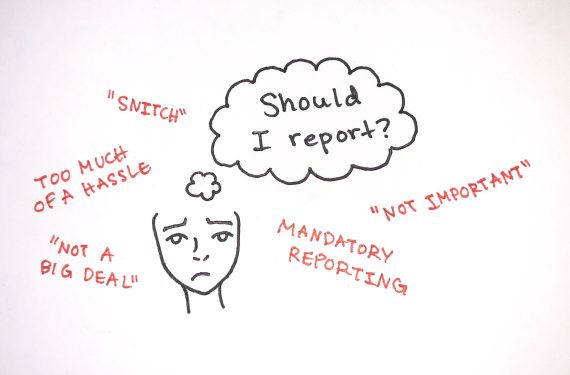
Reporting discrimination or harassment can be difficult, and you may experience a range of emotions when considering whether or not to report such conduct. You may think it will be too much of a hassle to report, or think that the conduct wasn’t serious enough to report. You may worry that you’ll experience retaliation as a result of filing a report.
However, if you or someone you know feel you have been a victim of discrimination and/or harassment at Tufts, we strongly encourage you to report the incident promptly so that OEO can address the incident as soon as possible. When in doubt, reach out!
Used with permission of artist
Reporting Options
At Tufts, you have options for reporting discrimination and/or harassment. Any or all of these options are available to Tufts community members and can be used regardless of whether you choose a formal or informal path forward.
Contact OEO Directly
You can contact us right here at the OEO, where we can provide information about your options for next steps, including how and whether to choose a formal or informal process. We can also connect you with support and resources. For students, we can provide things like housing changes, academic support, and counseling, and for employees we can provide other interim measures.
File a report via Ethicspoint
EthicsPoint is a third party secure web tool that allows you to anonymously or confidentially report sexual misconduct, discrimination or harassment.
When you report via Ethicspoint, OEO staff will use the Ethicspoint message function to anonymously communicate with you to offer support, answer questions, request or share information, and provide status updates. Just remember to keep the key code the system assigns to you after you submit so that you can check back on the progress of your report.
Talk to a OEO Liaison
OEO Liaisons are specially trained staff from different schools within Tufts University. All OEO liaisons are available to receive reports from students, faculty, staff, patients, visitors and other community members regarding any type of discrimination or harassment, including sexual misconduct. OEO Liaisons can also provide information regarding support, resources and disciplinary options within the University. OEO Liaisons direct the information they receive to OEO and the Title IX Coordinator at OEO.
Additional Reporting Options for Students
In addition to contacting OEO, Ethicspoint, or an OEO Liaison, students have several additional options for reporting.
You can contact Tufts University Police Department (TUPD) to report incidents of discrimination and/or harassment. The TUPD can do things like help you file a criminal complaint, provide transportation to the hospital or to court, discuss a No Trespass Order and help support court-ordered restraining orders. Contact TUPD.
You can also submit an educational/academic complaint with the DOE at:
Office for Civil Rights (OCR)
5 Post Office Square
Eighth Floor
Boston, MA 02109-3921
617-289-0111
The DOE and the OCR prohibit discrimination based on race, color, national origin, sex, disability, pregnancy status, age and retaliation for filing or participating in a complaint on any of the above. While OCR complaints should generally be filed within 180 days of the last date of the alleged discrimination, OCR may extend this filing deadline in a variety of circumstances.
Additional Reporting Options for Faculty and Staff
Any employee in a work environment with six or more employees can file a complaint with the MCAD.
John McCormack Building
One Ashburton Place
Sixth Floor, Room 601
Boston, MA 02108
617-994-6000
Worcester City Hall
455 Main Street
Room 101
Worcester, MA 01608
508-799-8010
MCAD prohibits employment discrimination based on race, color, religion, national origin, ancestry, sex, gender, age, criminal record (applications only), disability, retaliation, sexual harassment, sexual orientation, a transgender identity, genetics, military status and retaliation for filing or participating in a complaint on any of the above. The statute of limitations for filing a complaint is 300 days from the last date of discrimination.
The EEOC prohibits employment discrimination based on race, color, national origin, religion, sex, age, disability and retaliation for filing or participating in a complaint on any of the above.
JFK Federal Building
475 Government Center
Boston, MA 02203
800-669-4000
The EEOC prohibits employment discrimination based on race, color, religion, sex, age, disability, retaliation and national origin. The statute of limitations for filing a complaint is 300 days from the last date of discrimination.
Incident Reporting Process related to the Israel-Hamas war
Support and resources related to the Israel-Hamas war are available to all students, faculty, and staff. These support services include the university’s many existing and robust reporting systems for conduct concerns.
All members of the Tufts community are encouraged to report incidents of discrimination and harassment and are expected to cooperate fully with the investigation of these cases. The university prohibits retaliation against individuals who file such reports and all those who participate in the investigative process.
Students, employees, and community members can file complaints with Tufts University Police Department (TUPD), the Office of Equal Opportunity (OEO), or the relevant Dean of Students Office. An individual can report an incident to any of these offices and they will make sure it gets to the appropriate stakeholders.
Incidents related to the Israel-Hamas war often are related to race/color, national origin, ethnicity, religion, or the intersection of two or more of these or other categories protected by Tufts’ Non-Discrimination Policy. Instances of discrimination or harassment are reported to the Office of Equal Opportunity (OEO) by filing an electronic report, directly contacting OEO, or speaking with an OEO liaison. Community members with first-hand knowledge or information about an incident related to the Israel-Hamas war also can file an anonymous complaint against an individual or organization using OEO’s secure online portal. While anonymous complaints may provide awareness of a situation or incident, Tufts is limited in the actions it may take with anonymous information.
Safety concerns or concerns about a crime can be reported directly to TUPD by phone or in person, or anonymously by using TUPD’s secure online portal.
Students are encouraged to report potential student code violations directly to their school’s Dean of Students office.
All of these offices and departments work in close collaboration with one another and will refer cases to each other as needed.
The nature of the complaint dictates which office or department will respond. In general, TUPD reviews complaints involving criminal allegations and determines the appropriate response based on the type and particulars of the incident. OEO reviews complaints involving discrimination or harassment based on protected categories such as race/color, national origin, ethnicity, and/or religion and uses investigative processes outlined on their website, and the appropriate Dean of Students Office reviews complaints involving code of conduct violations for their school.
If an investigation into a report related to the Israel-Hamas war results in a finding against a member of our community, the university will use its existing sanction and disciplinary procedures to address the individuals and/or organizations involved. Sanctions and disciplinary processes exist for all students, faculty, and staff at Tufts University. Human Resources determines sanctions for staff, the appropriate Dean or Provost’s Office determines sanctions for faculty, and the appropriate student services office at each school determines their students’ sanctions.
Students or student organizations charged with a violation will go through their school’s standard process that determines whether or not they are found to be responsible for those violations. If a student or student organization is found responsible, disciplinary sanctions may include warning, reprimand, disciplinary probation, suspension, and expulsion, as well as a range of educational components. Sanctions are determined on a case-by-case basis and are individually tailored to each student or student organization and the facts and findings in the case.
We understand that some members of our community would like more detail about how cases are addressed and resolved. Due to federal and state privacy laws, and consistent with its longstanding practice, the university does not share information about its investigative findings or sanctions with third parties, including those who are reporting or inquiring on behalf of a Tufts student or employee.
Need Help Now?
For immediate assistance to attend to your physical and/or mental well-being, click on the button below.
Tufts Non-Discrimination Statement
Tufts is enriched by the many experiences and perspectives each individual member brings to our community. Tufts does not discriminate in admissions, employment or in any of its educational programs or activities and prohibits discrimination and harassment against any student, employee, job applicants, applicants for admission, or third parties on the basis of protected categories. Those protected categories include race (including traits historically associated with race, including, but not limited to hair texture, hair type, hair length and protective hairstyles), color, national or ethnic origin, ancestry, shared ancestry, age, religion, disability (including those with a record of a disability), sex and/or gender, gender identity and/or expression (including a transgender identity as defined by the Commonwealth of Massachusetts), sexual orientation, military or veteran status, pregnancy, lactation, genetic information, the intersection of these identities or any other characteristic protected under applicable federal, state or local law. Retaliation is also strictly prohibited. Tufts is an equal employment opportunity. See the full Tufts Non-Discrimination Policy.